Pages

Showing posts with label Wonders of the web. Show all posts

Friday, February 11, 2011

Google Art Project

Announced on February 1st, Google Art Project digitally displays over 1000 works of art from museums like the Hermitage in St. Petersburg, Florence's Uffizi Gallery, the Tate Britain, Amsterdam's Rijksmuseum, and many more. You can do a Google Street View-style walk through of the galleries, make your own collections from the works on display, and the level of detail is mind-blowing (you can even zoom in one eye in Rembrandt's Night Watch - they won't let you get that close in the museum!).

Seriously, getting this close just wouldn't happen.

Artist information, data about the work itself, and links to more works by that artist are provided when you click on the white "i" information icon on the right side of the screen.

My one issue with this site is the inability to search among all of the galleries. For example, one of the art club members wanted to see something by pointillist Georges Seurat and I could not find a way to search for his works in all the museums contained in Art Project. However, a work-around would be to do a Google site search, such as "Seurat site:googleartproject.com" in the main Google web search.

That one gripe notwithstanding, it is a wonderful resource that allows detailed viewing of artwork for anyone with an internet connection, and hopefully the coming months will bring even more artwork and galleries.

Tuesday, February 02, 2010

Wonder of the Web: Wolfram|Alpha

If you are not aware of the Wolfram|Alpha computational search engine, you probably should be. It's really something else - as it states on the homepage: "Today's Wolfram|Alpha is the first step in an ambitious, long-term project to make all systematic knowledge immediately computable by anyone."

I don't know who these people are, but they need a lot more initiative. Sheesh. (Actually, you can now watch the man responsible for WolframAlpha give a dynamic 20-minute presentation.)

At any rate, it turns out that Wolfram|Alpha can actually give step-by-step solutions to quadratic problems, as demonstrated in this blog post. It can also be a very handy search engine for finding anything from finding out how many milliliters are in 10 Tbsp, the population density of Ghana (given by square mile, square kilometre, and square foot, no less), or where the note A is located on a keyboard (it will even play the note for you!).

Hundreds of other examples are also available, from elementary math to ocean comparisons to languages.

Notably, Wolfram|Alpha provides what they call source information for the data presented in their results, which are not necessarily where the information came from but further sources for similar information. These other sources are conveniently linked in the source information list.

This is definitely worth a look for those interested in math and science, but Wolfram|Alpha has data that applies to pretty much every other subject area as well.

Thursday, January 15, 2009

Wonder of the web: The Big Picture blog

I just discovered the Boston Globe's The Big Picture blog last week, and already it has become a favourite of mine. Its premise is simple: provide stunning, high-quality, and newsworthy photographs to viewers. The result is a new set of about 20 photographs with captions three times per week, and the photos include jaw-droppers like this one of a polar bear:


And this photo of women in a Sudanese refugee camp:


And this shot of NASA shuttle Endeavour:


With a wonderful collection of images of international and current events, it is also possible to search the blog by month and category. Enjoy.

Friday, March 28, 2008

Book furniture

There is a lot of neat furniture and homes that are inspired by (and contain) books. I've collected some images and thought I'd share them here.


If you want to have a nightstand that looks like a pile of books (that are actually drawers), you're in luck!


Although I have my books organized by colour at home, it doesn't look nearly this impressive!


A bathtub with shelf space - genius!


A bookshelf that doubles as a staircase in a London apartment.


You don't need a bookmark with this shelf.

Wednesday, May 09, 2007

A Wonder of the Web: Project Gutenberg


Project Gutenberg is a website that provides over 20,000 free e-books that are out of copyright in the United States, from Jane Austen to Edgar Allan Poe to Sir Arthur Conan Doyle. The electronic books come in a variety of different file formats, such text files and audio files, and are rather easily downloaded (although sometimes you have to download the files in a number of parts).

I have to admit, I'm not one to read a book on a computer screen. However, I have found that the human-read audio books (as opposed to computer-read audio books) on Project Gutenberg are fantastic! There is everything from poetry to fairy tales to entire novels, and the volunteers who read the pieces I've listened to have been wonderful.

Enjoy!

Friday, January 26, 2007

A Wonder of the Web - Holy Land Maps

Holy Land Maps is pretty much exactly as it sounds: a website that has maps of the Holy Land (which includes modern-day Israel, Egypt, Jordan, Iran, Syria, and Palestinian Authority). What makes it special is that the maps are at least 85 years old and as much as 600 years old.

Click on the image above to go to the website homepage.

The maps are scanned from the Eran Laor Cartographic Collection at the Jewish National & University Library in Jerusalem, Israel, and the collection is searchable by date, by person (who created the map), and by location.

This site is a lot of fun to browse through - especially if you enjoy looking at maps (like I do). One of my favourites is this one, published in 1486:

A close-up of Babylon.

There is also this one.

A fish convulsing in the Mediterranean.

The maps are works of art and definitely worthwhile to look at, especially if you're interested in the evolution of mapmaking.

Friday, December 08, 2006

A wonder of the web - Del.icio.us

Del.icio.us is fantastic! It has become one of my favourite internet tools since I learned about it last year. What it does is allow you to save links to webpages that you can access from any internet connection, which is a whole lot better than just having a Bookmarks or Favorites folder on your computer (because you can only access those bookmarks from that computer). All you have to do is create a free account and start posting (adding) websites.

Take a look at what the PRHS library account looks like.

When you post websites you can also add tags, or descriptive words to help you find that website later in your del.icio.us account. For example, if you added this blog to your del.icio.us account, you might use the tags "PRHS," "library," and "blog." I currently have 90 items in the PRHS library del.icio.us account and my tag cloud looks like this:


The bigger the tag in the tag cloud above, the more posts I have tagged with it. Also, if you click on one of those tags, perhaps "astronomy," you will get a list of all the websites that I have tagged with the word "astronomy." You can also bundle the tags, which basically makes folders that contain all the posts that contain a particular tag or set of tags. If you go to http://del.icio.us/prhslib/space it is the bundle of all the posts that contain the tag "space."

You might have noticed that anyone can look at the PRHS library's Del.icio.us account and its contents. Although I am the only one who can add more websites, anyone can access the links themselves, which is great for student projects (like the grade 9 project on space) because it is accessible from any internet connection.

So, if you are interested in making your own del.icio.us account, go here to get started.

Enjoy!

Friday, November 24, 2006

A wonder of the web: Worldmapper

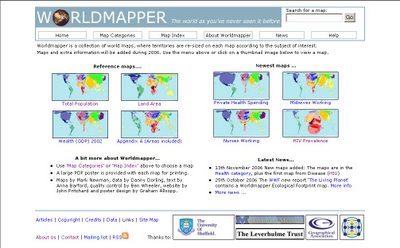
Worldmapper is a website out of the University of Sheffield in Britain that has dozens of beautiful and fascinating maps of the world - dozens because the cartographers (people who make and study maps) mapped the world according to things other than geography and political boundaries. Below is a screenshot of their homepage, and note the different looks of the maps:


Click on the image above to view the Worldmapper homepage.

Don't look like your usual maps of the world, do they?

This site currently has 227 maps of everything from Land Area to Tourist Destinations to Cars Exports (check out how massive and distorted Japan is!) to Forest Loss. Each map is linked to a descriptive webpage that outlines exactly what the map is about and contains a PDF poster that contains further information and can be printed out and displayed. Check it out!

Monday, November 20, 2006

A wonder of the web: LibraryThing


LibraryThing has become my new favourite internet toy, and it does some really interesting things with books.

First of all, people from all over the world log on and enter books that they own or that they have read into their "library," or personal collection of books. They also use tags in order to help find their books, like Flickr uses tags for photos. You can look at the tag cloud for PRHS's account to see what tags can look like.

After people have entered books into their libraries (and there are now over 8 million books in LibraryThing), LibraryThing can do some analysis and find out things such as:
- how many people own a certain book
- what books you might like based on what you've already got in your library or a book you've already read - this is the Book Suggester feature.
- and what books you might NOT like if you enjoyed a particular book - this is the Book Unsuggester.

I also use LibraryThing to generate those lists of new books that you see on the right side of this page if you scroll down.

What do you think of LibraryThing? Leave a comment and let me know!